
HR Has Evolved — And So Has the Role It Plays in Your Organization
From reactive compliance to proactive strategy: Understanding the shift that separates growing companies from stagnant ones.
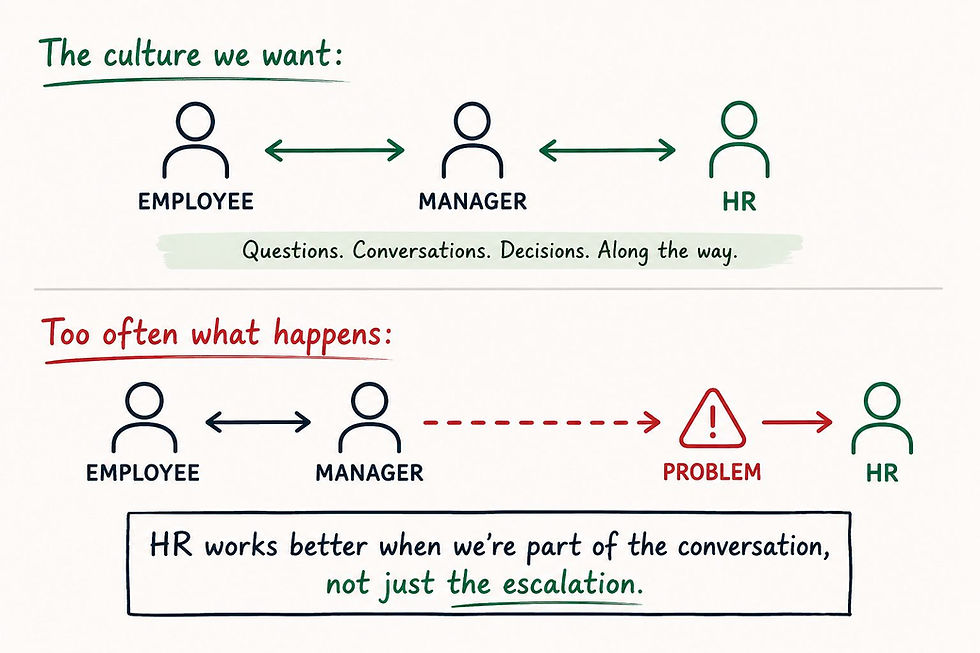
For a long time, HR was viewed primarily as a support function: reactive, transactional, and focused on compliance. While those elements are still important, they're no longer enough to support growing, complex organizations - especially those managing multiple entities, locations, or rapid change.
The modern workforce demands more. Organizations today are navigating hybrid work models, multi-generational teams, evolving employment law, and intense competition for talent. In this environment, HR can no longer afford to simply respond - it must lead.
So what does that shift actually look like in practice? Let's break it down.
HR Support vs. Strategic HR Partner
The difference between traditional HR support and a strategic HR partnership isn't just about titles or org charts - it's about how HR functions at every level of the business.

Why the Shift Matters Now
The difference isn't cosmetic. When HR functions as a strategic partner, leadership teams gain an all at the table - someone who helps translate business goals into people decisions, and people challenges inro business solutions.
This is especially critical for organizations experiencing:
Multi-entity or multi-location growth
Where compliance complexity multiplies and culture must be actively managed across sites.
Rapid organizational change
Mergers, restructuring, or scaling fast — where reactive HR creates costly delays and mistakes.
Talent attraction and retention pressure
Where employer brand, compensation strategy, and career development must be intentionally designed.
Evolving employment law and compliance requirements.
Where staying ahead of risk is far less expensive than reacting to it after the fact.

What Strategic HR Actually Looks Like
Strategic HR isn't a mindset shift alone — it's a structural and operational one. Here's what it looks like when HR is truly embedded at the leadership level:
Workforce Planning
Instead of filling roles reactively when someone leaves, strategic HR analyzes workforce data to anticipate gaps 6–18 months out. Succession planning, skills mapping, and headcount modeling become standard practice — not emergency responses.
People Strategy Aligned to Business Goals
Every major business initiative — a new product launch, a market expansion, a technology investment — has a people dimension. Strategic HR ensures that dimension is planned for, resourced, and executed well.
Risk Reduction Through Proactive Compliance
Rather than scrambling to meet regulatory changes, strategic HR builds compliance infrastructure that adapts. Employment law audits, policy updates, and training programs are scheduled and systematic — not reactive.
Leadership Development & Culture
Sustainable growth requires strong leaders at every level. Strategic HR builds the programs, frameworks, and feedback loops that develop leadership capability from within — protecting culture even as the organization scales.

So, How Is HR Showing Up in Your Organization?
The question isn't whether your organization needs HR. Every organization does. The real question is whether your HR function is positioned to support the business you're building today — and the one you're working toward tomorrow.
If HR is still primarily task-based and reactive, you're likely leaving strategic value on the table. And in today's competitive landscape, that gap is one your competitors are eager to exploit.
The good news: the shift from HR support to strategic HR partner is achievable. And it doesn't require starting from scratch — it requires the right partner, the right framework, and the willingness to think differently about what HR is for.
Is HR showing up as a support function —
or a strategic partner — in your organization?

Comments